theclearances.org

North Uist

Seaweed and the 1803 Passenger Act

Further readingCampey: Fast Sailing
Campey: Fine Class of Immigrants
Hunter: Crofting Community
Hunter: Last of the Free
Richards: Clearances

Lucille H Campey, in A Very Fine Class of Immigrants writes,

‘it was widespread concerns over the suffering caused by overcrowded ships which mobilised the Highland Society of Edinburgh to campaign for changes in the legislation governing passenger travel by sea.’
It is certainly true that the lobbying of this Society helped bring about the passing of the 1803 Passenger Act but the belief that this was as a result of concern over suffering, unless it was economic suffering to the landlords, is naive in the extreme. Other than the occasional nod to Highland culture, with the publication of a Gaelic dictionary, the Highland Society of Edinburgh was effectively a pressure group of Highland landlords, their factors and their Edinburgh law agents. Prominent among these was MacDonald of Clanranald’s factor Robert Brown. He pushed the view, also promulgated by that other font of benevolence, Lord Macdonald, that emigrants were the victim of unscrupulous emigration agents skilled in the ‘arts of deceit and imposition’. Their opposition to emigration, then, was concealed in a humanitarian cloak but what was the real reason for their opposition?

The answer, unlikely as it may seem, is seaweed. Burning seaweed produces kelp ash, an alkali source, an important constituent in glassmaking at the end of the 18th century. It was also crucial in the textile industry: mixed with quicklime (CaO) it was used as a bleach; in soap form it washed wool and, for dying, it was an ingredient in muriate of potash (KCl). The requirements of shipbuilding led to legislation which prevented wood being burned to produce this so the seaware of the Western Isles became extremely attractive as an economic resource.

The kelp, though, did not come from just any seaweed washed ashore, the best sources lay underneath rocks some distance offshore which had to be cut by workers wading out and cutting it with scythes. It was then dragged ashore and dried, before burning, all in all a most labour-intensive activity and a most unpleasant one,

‘If one figures to himself a man, and one or more of his children, engaged from morning to night in cutting, drying, and otherwise preparing the sea weeds, at a distance of many miles from his home, or in a remote island; often for hours together wet to his knees and elbows; living upon oatmeal and water with occasionally fish, limpets and crabs; sleeping on the damp floor of a wretched hut; and with no other fuel than twigs or heath: he will perceive that this manufacture is none of the most agreeable.’
Second Report to the Commissioners and Trustees for Improving Fisheries and Manufactures in Scotland, 1755

Hard and unpleasant though the work was it was very lucrative, for the landlord that is, not for the worker. Hunter (in The Making of the Crofting Community) estimates the wages of the kelp harvester at between £1 and £3 per ton for the entire period from 1790 until the collapse of the industry. It was during this period that fortunes were made by the landlords who “owned” the kelp. Spanish barilla, which provided a larger proportion of alkali on burning was prevented from reaching the British market by the Napoleonic Wars. Kelp, therefore, reached prices of £20 per ton. As the entire manufacturing process was carried out by cheap island labour, this constituted pure profit for the landowners. Even the small cost of labour did not really need to be met: the labourers were crofters and either had a requirement to work so many days each year for their landlord or, alternatively, the kelping was deducted from their rent payments, so, as Hunter writes in Last of the Free,

‘It was little wonder, then, that landlord after landlord was prepared to subordinate all other land management considerations to the almost unbelievably lucrative business of making and marketing kelp.’
The landlord to benefit most from this industry was Lord Macdonald of Sleat. When he undertook a survey of his estates in Skye and North Uist in 1799-1800 he may well have felt that he did ‘not want to dismiss great numbers of his tenants’ in the reorganisation, as Eric Richards quotes in his favour, but that was in keeping with his surveyor, John Blackadder’s suggestion that, once the inland localities were cleared for sheep, those removed could be resettled on coastal crofts where
‘from the surrounding ocean and its rocky shore immense sums may be drawn .... As these funds are inexhaustible, the greater the number of hands employed so much more will be the amount of produce arising from their labour.’

To make sure that there would not be sufficient income in the farms alone for the displaced tenants, the new crofts were laid out on barren land ‘in the least profitable parts of the estate’, a situation helped in Skye by a proposed rent rise of 75% between 1799 and 1803.

The only thing which could interfere with this revenue stream for the financing of Armadale Castle was emigration and this was effectively halted by the 1803 Passenger Act. It reduced the number of passengers which could be carried on a vessel (by specifying a minimum amount of space for each) and established requirements for minimum levels of food, water and medicine to be carried on board. The net effect was to raise the minimum cost of a passage to Nova Scotia from £4 to £10 pricing it largely beyond the reach of Lord Macdonald and Clanranald’s tenants.

Lest it be thought that this is too cynical a view of the motives behind the act, these are the words of Charles Hope, its chief architect ,

‘I had the chief hand in preparing and carrying thro’ parliament an Act which was professedly calculated merely to regulate the equipment and victualling of ships carrying passengers to America, but which certainly was intended both by myself and other gentlemen of the committee to prevent the pernicious spirit of discontent against their own country, and rage for emigrating to America’
With the end of the Napoleonic Wars, the kelp monopoly was gone. Although tariffs protected it against Spanish imports for a while, these were soon abandoned and, in any case, the Leblanc process offered far cheaper sources of alkali. The industry collapsed and the need for a large and cheap labour force was gone. Many of the requirements of the 1803 Act were lost in new legislation in 1817 and emigration, which now suited the landlords, was made easier. By 1849, before beginning the brutal clearances of North Uist, best remembered for the events at Sollas, Macdonald would bemoan the fact that the island was so densely populated.

Recommended Books

 Book
Buy the Book"Fast Sailing and Copper-Bottomed": Aberdeen Sailing Ships and the Emigrant Scots They Carried to Canada, 1774-1855
A Very Fine Class of Immigrants: Prince Edward Island's Scottish Pioneers, 1770-1850
Last of the Free: A Millennial History of the Highlands and Islands of Scotland
The Highland Clearances
The Making of the Crofting Community
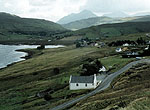
Ben Eval and Loch Obisary, North Uist, from postcard ca. 1905
Size: 400x262 (29 KB)
© 2001, Douglas MacKenzie - All rights reserved
Click on the image above to view the full size image